Langfuse v4 is live: faster at scale, with more ways to search, monitor, and evaluate
 Max Deichmann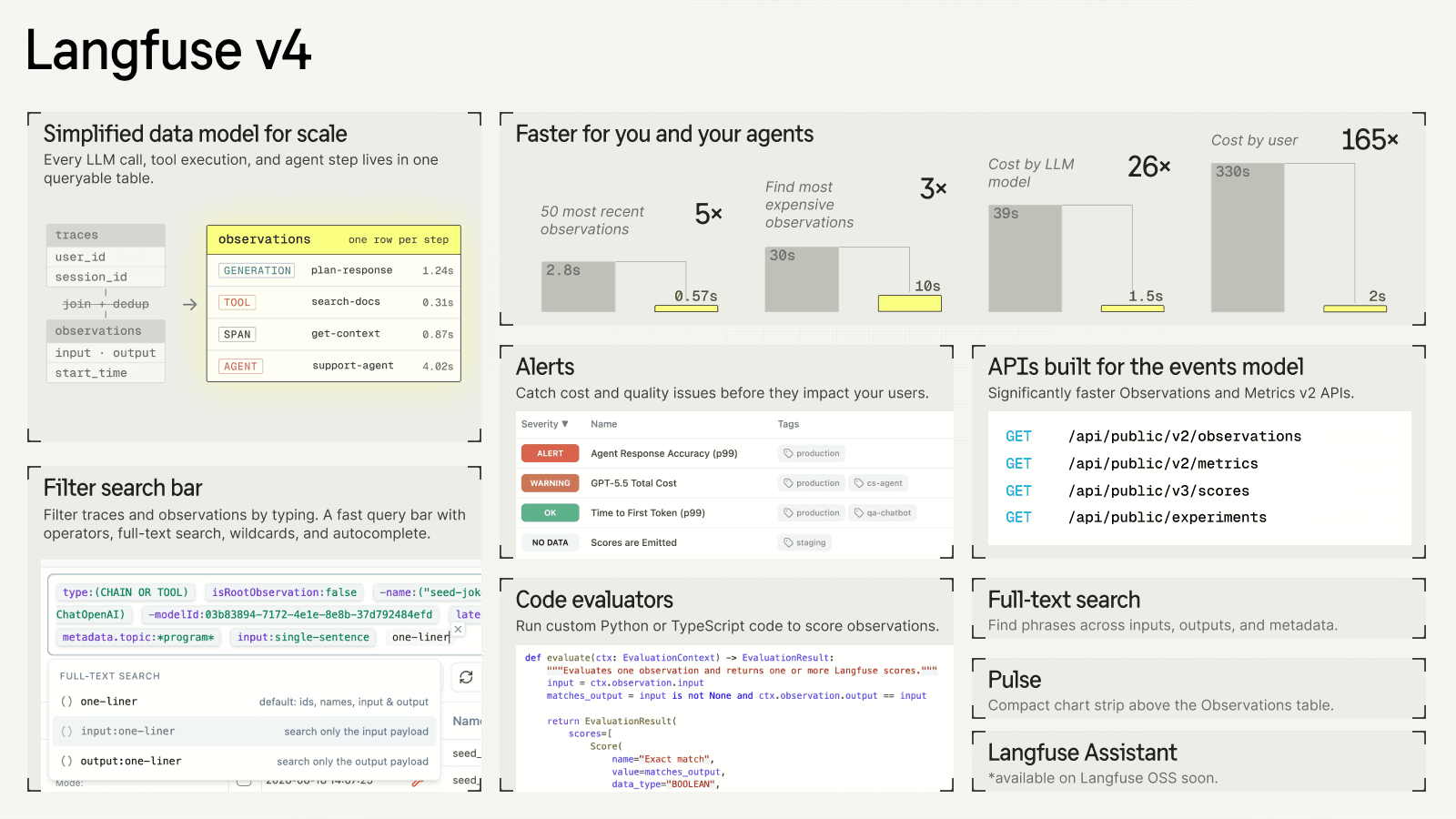
Query and evaluate every agent step directly, with initial table loads in milliseconds and at least 10x faster dashboards for large projects.
Langfuse v4 is live on Langfuse Cloud and generally available for self-hosted deployments. It makes it faster to debug, evaluate, and monitor complex LLM applications by letting you work with every LLM call, tool execution, and agent step directly. Initial table loads over large datasets drop from seconds to milliseconds, and dashboards over longer time ranges load at least 10x faster in large projects.
Langfuse Cloud becomes v4-only on November 9, 2026. Most projects need no migration. If Action required lists checks for your project, complete them before this date.
New to Langfuse
There is nothing to migrate. Start tracing with the v4 data model.
Using Langfuse Cloud
Open Action required and complete only the checks detected for your project.
Self-hosting Langfuse
Plan the upgrade on your schedule and review the infrastructure requirements first.
What we shipped in Langfuse v4
Langfuse v4 is much faster and also ships new ways to search, monitor, evaluate, and query your application data.
Monitors
Watch cost, quality, and latency thresholds and notify teams through Slack, webhooks, or GitHub Actions.
Code evaluators
Run deterministic Python or TypeScript checks on live observations and experiments.
Filter search bar
Combine typed filters, metadata, and scores in one shareable query.
Full-text search
Find words and phrases across observation inputs, outputs, and metadata.
Pulse
Plot count, cost, or latency above the Observations table and select a spike to inspect its operations.
Langfuse Assistant
Ask questions about traces, observations, sessions, and metrics in plain language.
Observations API v2
Retrieve selected observation fields with cursor-based pagination.
Metrics API v2
Aggregate cost, tokens, volume, latency, and scores across observations.
Upgrade Langfuse Cloud projects
Langfuse Cloud becomes v4-only on November 9, 2026. Complete any migration actions for your projects before this date.
New managed projects already use v4 and need no migration. For existing projects, organization owners can open Migration status to see every project. The page marks each project as Up to date or shows exactly what needs to change.
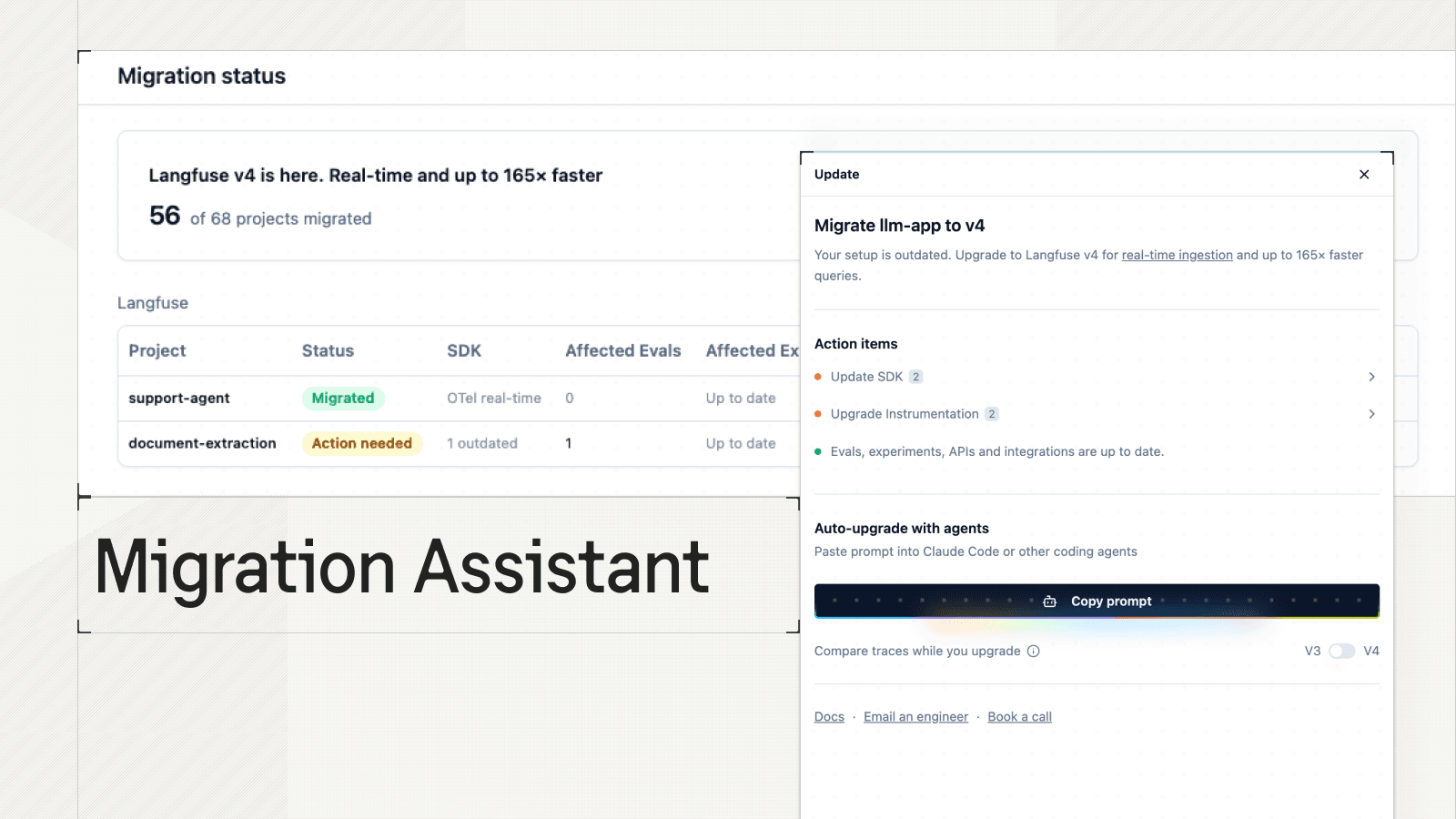
We will email project owners and admins a summary of the actions detected for their projects. Complete those actions by November 9, 2026. Action required remains the live source of truth, and the Cloud upgrade guide covers every check and its migration steps.
You can find more details in the upgrade guide.
Upgrade self-hosted Langfuse instance
Langfuse v4 is generally available for self-hosted deployments. There is no forced cutover date, and Langfuse v3 will receive security patches through January 2027.
Follow the self-hosted v3 to v4 migration guide to review the infrastructure requirements and plan your upgrade.
Technical background: V4 does less work for the same query
- Queries scan less data. One denormalized observations table replaces read-time joins between traces and observations.
- Ingestion writes less data. Each completed observation is written once, which reduced S3 costs in our ingestion pipeline by roughly 80%.
- Immutable data creates room to optimize. Append-only observations give us the architectural freedom to introduce optimizations such as materialized views in the future.
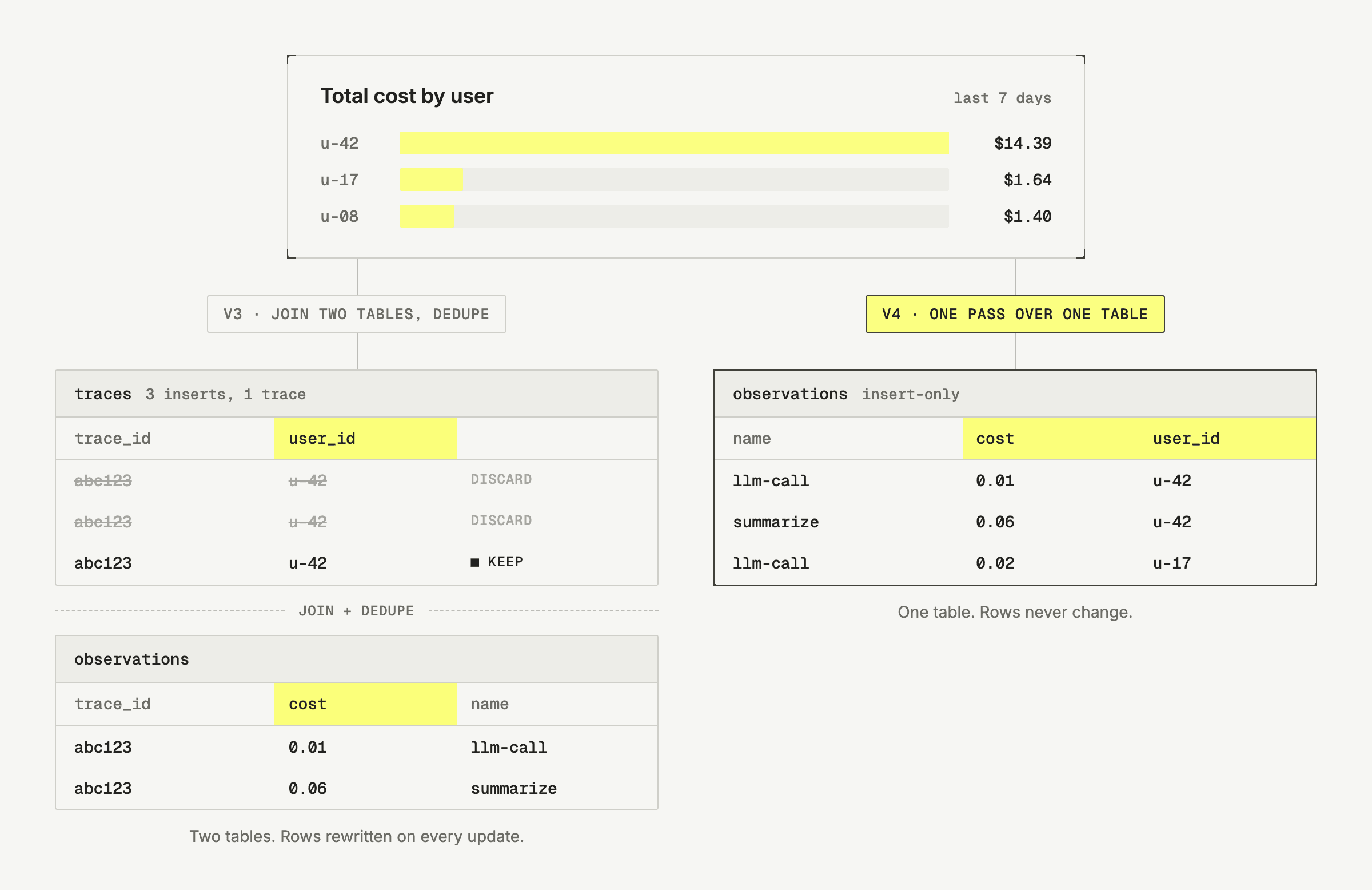
Older SDKs sent updates to both traces and observations, which we stored in separate tables. Before ClickHouse could return a result, it had to join those tables and deduplicate the updates. This was slow at scale.
The Langfuse Python SDK 4.7.0 or later and JS/TS SDK 5.4.0 or later add trace-level attributes such as user_id and session_id to every observation before it is ingested into Langfuse. Each observation is written to a new immutable, append-only table. The same query now needs neither a join nor deduplication, which makes it much faster.